

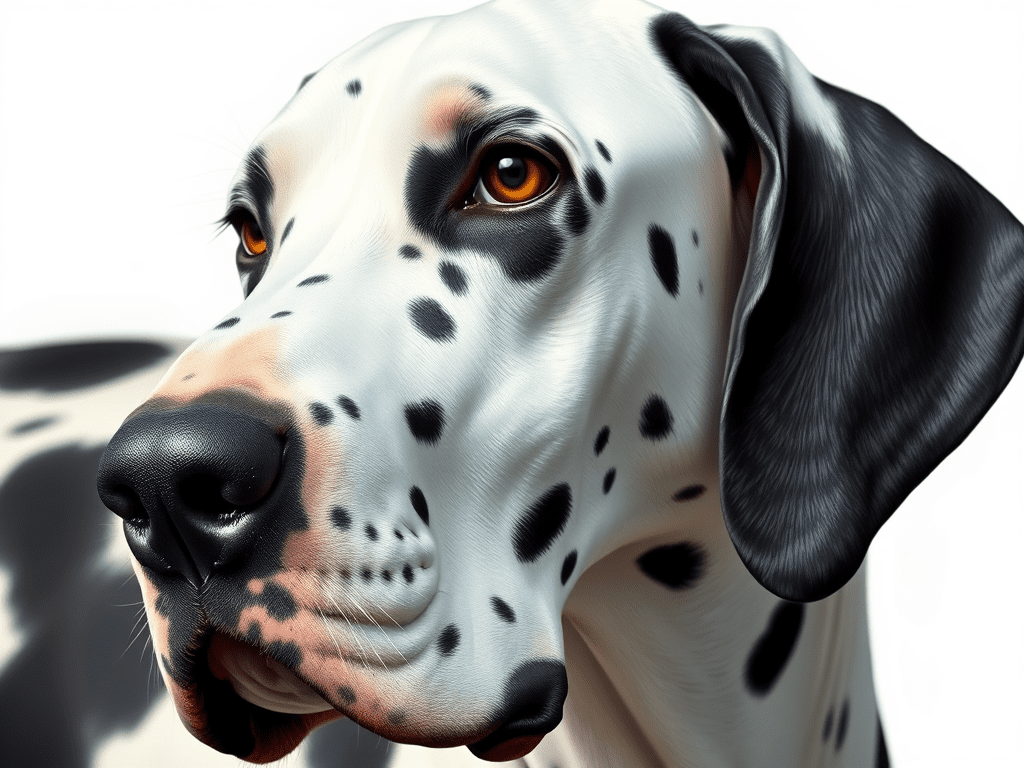
Why can’t Harlequin be expressed without the Merle gene?
The Harlequin gene cannot be expressed without the Merle gene because Harlequin is a modifying gene, meaning its sole biological function is to alter the way another specific gene’s pattern appears.
Here is exactly why the two genes must work together:
• The Modifier Mechanism: The Merle gene (SILV or PMEL17) creates a mosaic pattern consisting of dark, fully pigmented spots over a diluted (often grayish) background coat. The Harlequin gene (PSMB7) acts specifically upon this merled canvas; it removes the dilute background pigment, turning it pure white, while simultaneously increasing the size of the dark, fully pigmented spots.
• Nothing to Modify: If a dog inherits the Harlequin gene but has a normal, non-merle genotype (mm), there is no dilute background pigment for the Harlequin gene to remove. Because there is no merle pattern to act upon, the Harlequin modifier has absolutely no visible phenotypic effect on the dog’s coat.
• Hidden Carriers: Because the gene requires Merle to work, a dog without the Merle gene can possess the Harlequin gene but visually appear as a normal, solid-colored dog (such as a solid black or a black dog with white “mantle” spotting). Breeders refer to these dogs as “carrying” the Harlequin gene because, although they do not display the pattern, they can pass it to their puppies.