

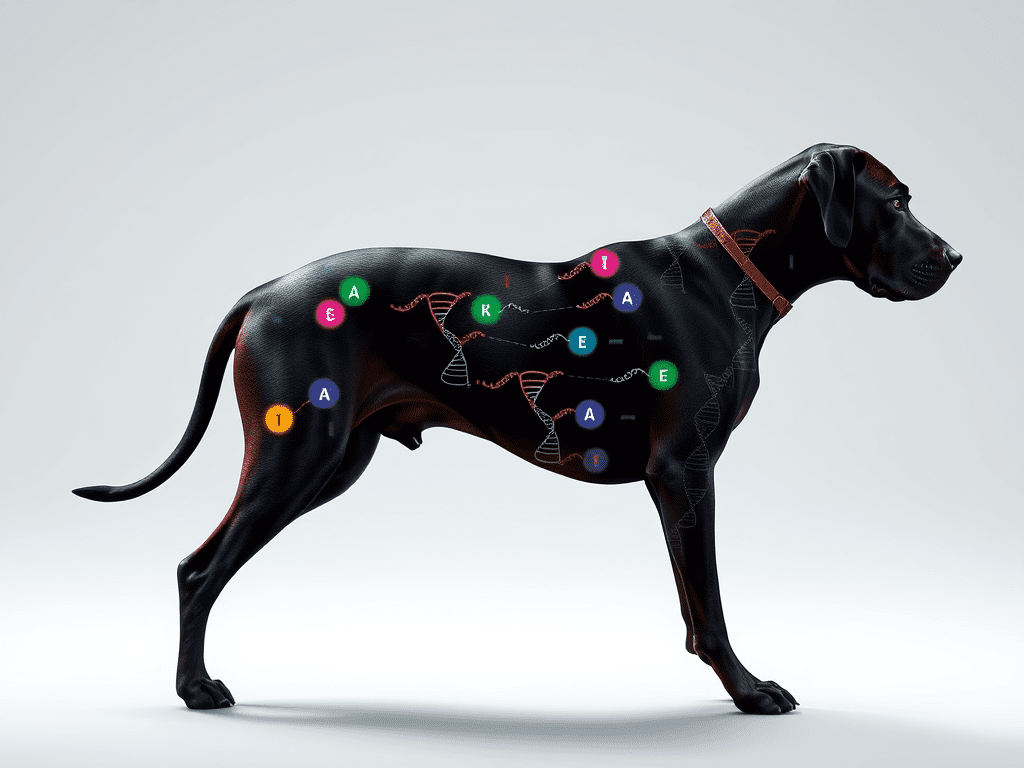
How do researchers use the K, A, and E loci?
Researchers use genetic testing of the K, A, and E loci to uncover a dog’s hidden genotype, predict the coat colors of future offspring, and understand how different pigment genes interact.
The K Locus (CBD103 gene). Often referred to as the dominant black gene, the K locus determines whether a dog has a solid dark base or expresses fawn or brindle patterns. Researchers use tests at this locus to determine if a solid black dog is homozygous for dominant black (KB/KB) or if it is secretly carrying recessive genes for fawn (K
y
). Currently, researchers are unable to specifically test for the brindle mutation (K
br
) using a DNA color test, so they must rely on observational data and breeding outcomes to assume its presence.
The A Locus (ASIP gene) and the Agouti Signaling Protein gene control the switch between black pigment (eumelanin) and red/yellow pigment (phaeomelanin). Researchers use testing at the A locus to identify specific pattern alleles, such as fawn/sable (a
y
), wild sable (a
w
), and tan point (a
t
). Researchers utilize this test to predict the color outcomes of specific matings and to determine the underlying color of dogs with extensive white spotting patterns that obscure their pigmented fur. Because the A locus relies on the K locus, researchers know that a dog will only visibly express these A locus traits if it possesses the recessive K
y
alleles.
The E Locus (MC1R gene) controls the presence of the black mask trait. Researchers use DNA testing at the E locus to determine if a dog carries the dominant masking allele (E
M
). This tool is highly useful for researchers and breeders because a black mask can be completely hidden on dogs with dark coats or distinct spotting patterns, such as solid blacks, blues, merles, and harlequins. By testing the E locus, breeders can determine whether a dog is homozygous for the mask (meaning it carries two copies), which guarantees that it will pass the mask trait to all of its puppies regardless of the mate.