

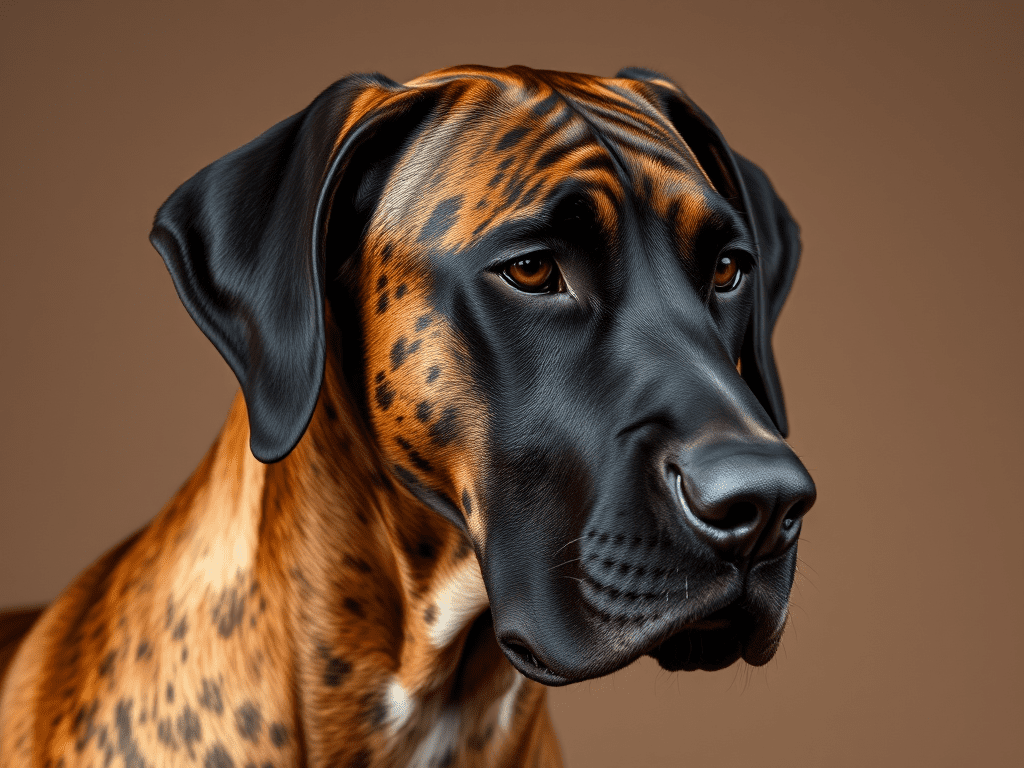
How do the A, E, and D loci interact differently?
The A, E, and D loci interact to determine a Great Dane’s coat color, but they play fundamentally different roles in how they distribute and modify pigment.
Here is how their interactions differ:
• The A Locus (Agouti/ASIP gene) determines the base pattern: This locus controls the distribution and switching between dark pigment (eumelanin) and red/yellow pigment (phaeomelanin) across the entire body. It is responsible for determining whether a dog has a solid dark base or specific patterns, such as fawn (sable), wild sable, or tan points. However, A-locus traits are only visibly expressed if the dog’s K-locus (dominant black gene) allows it.
• The E Locus (Extension/MC1R gene) overlays specific traits onto the base: The E locus interacts directly with the A locus to control pigment switching, but in Great Danes, its most notable role is controlling the black mask (E
m
). The E locus interacts with the A locus’s base color: if the A locus produces a lighter fawn or brindle dog, the E locus’s black mask will be clearly visible. If the dog is solid black, blue, or heavily spotted, the mask is still genetically present but hidden by the dark coat.
• The D Locus (Dilute/MLPH gene) globally dilutes the other loci: Unlike the A and E loci, which determine where and what type of pigment is placed on the dog, the D locus acts as a global modifier that affects the intensity of the pigment already determined by the other genes. If a dog inherits two recessive dilute alleles (d/d), the D locus will lighten any black pigment coded by the A and E loci into blue (grey).
In summary: The A locus builds the underlying pattern (like a fawn coat), the E locus can add specific features on top of that pattern (like a black mask), and the D locus interacts with both by optionally diluting whatever dark pigment they have produced (turning a black mask into a blue mask).